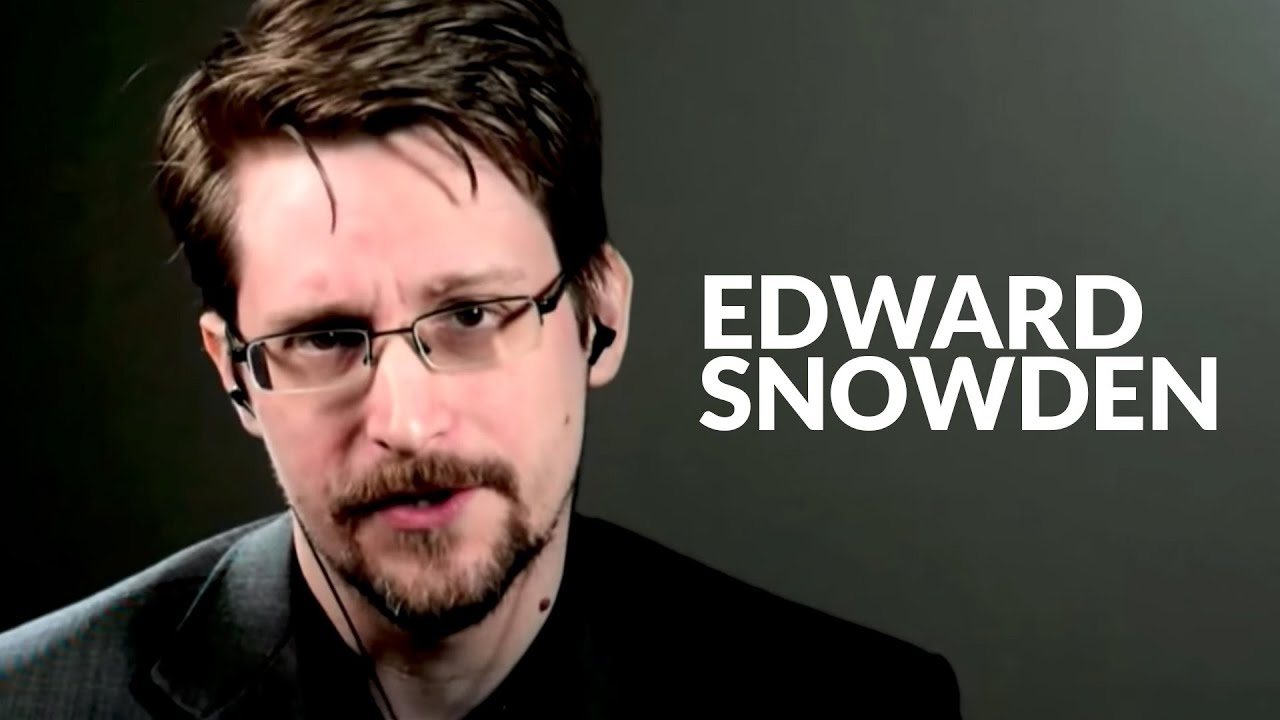
It was a little after 6 p.m., and the NSA whistleblower's face and shoulders were gazing out, billboard-sized, at hundreds of cheering young libertarians. Snowden was beamed in to talk to the largest-ever International Students for Liberty conference, newly relocated to Washington's largest hotel. Snowden, whose highest degree was a GED, was honored as an honorary alumnus of the eight-year old organization. For 15 minutes he restated a case against the surveillance state that had no rebuttal in the room.
"As they take the private records of all our lives, and they aggregate a dossier, how can that be said to be constitutional?" asked Snowden. "Why have we funding and instituting this system of mass surveillance of people in our country and people around the world if there’s no track record that shows it works?"
As he honed in on his argument, Snowden tailored it to young
libertarians -- most of them college students. "I think many of the
people in this room take a more pro-liberty pro-rights perspective than
others in the U.S. political agreement," said Snowden. "There’s an
argument to be made that perfect enforcement of the law is not a good
thing. In fact, it’s a very serious threat... law is a lot like
medicine. When you have too much it can be fatal."
Alexander
McCobin, the president of the Students for Liberty, posed a few
friendly questions. First, did Snowden regret anything?
"I’m
concerned that we’d be in a better place if I’d come forward sooner,"
said Snowden. He described a conversation he'd had with Daniel
Ellsberg, and how both of them came to regret how long it took them to
produce their leaks. "He like myself couldn’t get over the psychological
burden of fear of lawbreaking," said Snowden.
In a small moment of
irony, the Moscow-bound Snowden remembered how he'd talked to
colleagues at the NSA, and found them quietly agreeing with his
worries, but unready to expose the agency. "We had more on Americans
than we had on Russians, for example," he said. "Should we be focusing
on ourselves more than we focus on our adversaries?"
After Snowden
wrapped, a slightly smaller audience remained in chairs to hear former
Texas Congressman Ron Paul chat with Fox News commentator Andrew
Napolitano and Reason.com editor Nick Gillespie.
"You know, my name
was connected to Edward Snowden," said Paul. "They really wanted to
blackball him, to destroy him, so they said: He donated to the Ron Paul
campaign!"
Paul called Snowden a truth-teller, and asked why whistleblowers like him were demonized.
"They end up being called the evil people, they're evil," he said.
"Edward Snowden can't even come back to this country. They say he's
treasonous, because he's telling the truth. This is why organizations
like this are successful."
That won an ovation -- but Paul ran into
trouble when people got to lob questions at him. Gillespie asked Paul
about a controversy that broke out in 2014, when he said that Ukraine's
government had been replaced in a "fascist coup" and that its subsequent military moves were legal.
"I'm not pro-Putin, and I'm not pro-Russia, but I'm pro-facts," said
Paul. He contrasted his laissez faire view of international relations
with that of "the neocons" who'd supported western Ukrainians in their
coup against the government. "Just take a look at what's happened in the
last 25 years, it's a total failure of a foreign policy."
Two
European students, one a Russian living in Ukraine, challenged
Paul. Why did he defend Russia's sovereign right to take Crimea after
the province (while under Russian occupation) decided to secede from
Ukraine?
"Well, Crimea, it's not a foreign country according to the Russians," said Paul.
After another defense of his policy, Paul got a question from a
student demanding he apologize for racist quotes that appeared in his
1980s and 1990s newsletters.*
"You continue to stand behind individuals who espouse racist, homophobic, and sexist ideas," said the student. "Why have you not explicitly condemned the authors?"
There was a mixture of boos and applause -- definitely more boos. Paul
brushed off the question. "You'd have to dig 'em up, because I can't
find stuff like that," he said. "I personally did not write the stuff
out, and I had said where I disagree on it. That is too broad, for me
to say I'm gonna disavow everything I wrote in a newsletter, that's
foolishness."
After a few friendlier questions, the panel wrapped,
and Paul headed to the opposite end of the ballroom, where hundreds of
students waited for a photo with him.

